
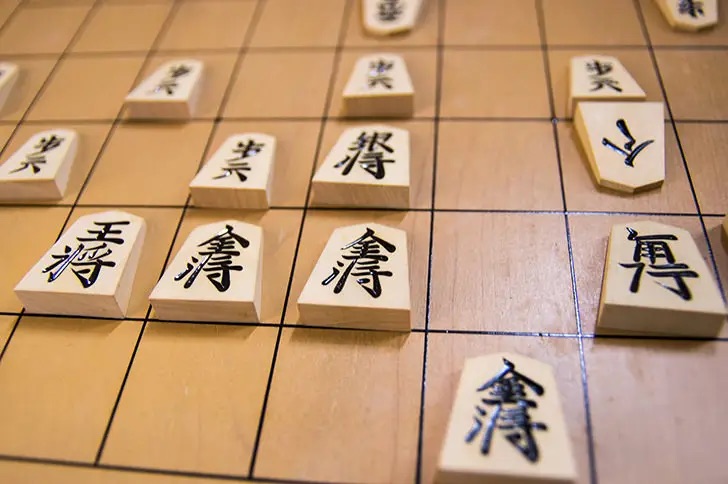
In shogi, almost every game begins with a fundamental strategic decision: will you keep your Rook on its starting square, or move it to a different file? This choice — Static Rook (居飛車, ibisha) vs Ranging Rook (振り飛車, furibisha) — shapes the entire course of the game and is the most important opening concept every beginner needs to understand.
What Is a Rook File?
The Rook (飛車, hisha) starts the game on the 2nd file (column 2) for the first player, and on the 8th file for the second player. The “file” simply refers to which column the Rook is positioned on. This starting file gives the Rook immediate influence along its column.
A player who keeps the Rook on or near its starting file is said to play Static Rook. A player who moves the Rook to a different file is said to play Ranging Rook.
Static Rook (居飛車, ibisha)
In Static Rook, the Rook stays on the 2nd file (or moves only slightly from its starting position). The main attacking plan typically involves pressing forward on the right side of the board along that file.
Characteristics of Static Rook
- Disciplined and systematic: Static Rook tends to create slower, more methodical games with long strategic plans
- Castle: Static Rook players typically use the Yagura Castle or Anaguma Castle to protect their king on the left side of the board
- Attack direction: The main attack usually develops on the right side (files 1–4), coordinating the Rook with Pawns and promoted pieces
- Deeply studied: Static Rook vs Static Rook matchups (particularly Yagura vs Yagura) have been analyzed to extraordinary depth in professional shogi literature
Best Static Rook Openings for Beginners
- Yagura (矢倉): The most classical Static Rook formation, featuring the Yagura Castle and systematic central control
- Right King (右玉): A more modern approach where the king moves to the right side
- Anaguma: Ultra-solid defensive setup that sacrifices early activity for late-game fortress strength
Ranging Rook (振り飛車, furibisha)
In Ranging Rook, the Rook moves from its starting file to a new position — typically the 4th, 3rd, or 2nd file counting from the left (files 4, 3, or 2 in standard notation). This repositioning takes one or two moves but gives the Rook a completely different attacking angle.
Characteristics of Ranging Rook
- Dynamic and aggressive: Ranging Rook creates active, unbalanced games with sharp counterplay
- Castle: Ranging Rook players almost always use the Mino Castle and its variations, protecting the king on the left side of the board while the Rook attacks on the right
- Attack direction: The main attack develops on the left side (files 5–9) using the repositioned Rook
- Beginner-friendly: Many coaches recommend Ranging Rook as the first opening system for beginners because the Mino Castle is easy to build and the attacking plans are direct
The Main Ranging Rook Positions
- Fourth File Rook (四間飛車, shiken-bisha): The most popular Ranging Rook opening. The Rook moves to the 4th file, directly opposite the opponent’s Bishop diagonal, creating an active defensive and offensive setup.
- Third File Rook (三間飛車, sanken-bisha): The Rook moves to the 3rd file, slightly further than Fourth File. Creates different attacking angles.
- Central Rook (中飛車, naka-bisha): The Rook moves to the 5th file — the center of the board. An aggressive choice that controls the center from the start.
- Second File Rook (向かい飛車, mukai-bisha): The Rook moves to the 2nd file (from the right), directly facing the opponent’s Rook. Creates a confrontational setup.
Which Should You Choose?
Both Static Rook and Ranging Rook are completely valid strategic approaches used at every level of shogi, including professional play. The choice comes down to your preferred style:
Choose Ranging Rook (especially Fourth File Rook) if:
- You are a complete beginner and want the simplest path to a solid, functional game
- You prefer active, attacking play
- You want to learn the Mino Castle, which is fast, flexible, and natural for Ranging Rook
- You enjoy games where your plan is clear from the start
Choose Static Rook if:
- You prefer methodical, strategic games
- You enjoy studying deep theory and classical positions
- You want to focus on Yagura Castle, which offers excellent all-around protection
- You are comfortable with slower-developing, complex middle games
Matching Castles to Opening Choice
The table below summarizes the recommended castle for each opening style:
| Opening Style | Rook File | Recommended Castle |
|---|---|---|
| Fourth File Rook | File 4 | Mino Castle → Silver Crown |
| Third File Rook | File 3 | Mino Castle |
| Central Rook | File 5 | Mino Castle or Boat Castle |
| Yagura (Static) | File 2 | Yagura Castle |
| Anaguma (Static) | File 2 | Anaguma Castle |
What Happens When They Meet?
When one player chooses Static Rook and the other chooses Ranging Rook, the game is called an opposing type matchup (相居飛車 or 対振り飛車). These matchups have their own established theory and are among the most studied positions in shogi. When both players choose the same type, the game is a same-type matchup (相振り飛車 for both ranging, 相居飛車 for both static).
As a beginner, do not worry too much about these matchup categories. Focus on building your castle reliably, developing your pieces logically, and executing your attack when your king is safe. The opening theory will make more sense as you gain experience.
Now that you understand the two main opening philosophies, move on to Lesson 8: Tsume Shogi for Beginners, where you will start training your tactical eye through checkmate puzzles.
コメントを残す