
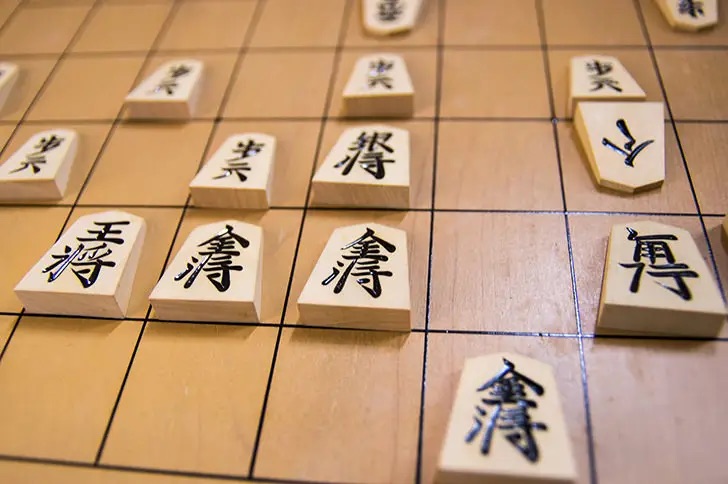
If you already play chess, learning shogi will feel both familiar and startling. The two games share a common ancestor — an ancient Indian strategy game called Chaturanga — but they have evolved into very different experiences. Understanding the key differences between shogi and chess is the fastest way to orient yourself as a new shogi player.
This guide covers every major difference between the two games: the board, the pieces, the rules, and the strategic philosophy each game demands.
1. The Drop Rule — The Most Important Difference
The single most important difference between shogi and chess is the drop rule. In shogi, when you capture an opponent’s piece, you keep it in your “piece stand” (持ち駒, mochigoma). On any future turn, instead of moving a piece on the board, you can drop a captured piece onto any empty square (with a few restrictions).
This changes everything. In chess, once a piece is captured it is permanently gone. In shogi, captured pieces re-enter the game for the capturing side. This means:
- Positions never simplify as dramatically as they do in chess
- Attacks can materialize suddenly from dropped pieces anywhere on the board
- Even when behind on material on the board, you may be ahead in hand pieces
- The game remains complex and dynamic until the very final moves
Drop restrictions: you cannot drop a piece where it would have no legal moves (e.g., a pawn on the last rank), cannot drop a pawn to immediately give checkmate (illegal in shogi), and cannot drop two pawns in the same column.
2. Board Size
Chess is played on an 8×8 board with 64 squares. Shogi is played on a 9×9 board with 81 squares. This extra row and column may seem small, but it significantly affects how pieces interact, how castles are built, and how attacks develop. Shogi’s larger board gives pieces more room to maneuver and means games tend to have longer middle games.
3. Number of Pieces
Chess starts with 16 pieces per side (8 pawns and 8 major/minor pieces). Shogi starts with 20 pieces per side — 9 pawns and 11 other pieces. The extra pieces in shogi include more lances and knights, and the two gold generals, which have no direct chess equivalent.
4. Promotion Zone
In chess, only pawns promote, and only when they reach the last rank. In shogi, most pieces can promote when they enter or move within the opponent’s promotion zone (the three ranks closest to the opponent). Promoted pieces gain new movement abilities:
- Promoted Pawn (と金, tokin): moves like a Gold General
- Promoted Lance: moves like a Gold General
- Promoted Knight: moves like a Gold General
- Promoted Silver: moves like a Gold General
- Promoted Bishop (馬, uma): moves like a Bishop plus one square in any direction
- Promoted Rook (竜, ryu): moves like a Rook plus one square diagonally
Gold Generals and Kings do not promote. This promotion system creates constant mid-game transformations that chess simply does not have.
5. Pieces That Have No Chess Equivalent
Several shogi pieces have no direct chess counterpart:
- Gold General (金将): Moves one square in any direction except diagonally backward. A powerful defensive piece that forms the core of every castle.
- Silver General (銀将): Moves one square diagonally or straight forward. More aggressive than the Gold, with a unique movement pattern.
- Lance (香車): Moves any number of squares straight forward only — like a rook restricted to one direction.
- Knight (桂馬): The shogi knight jumps in an L-shape, but only forward — two squares forward and one to the side. Unlike chess knights, shogi knights cannot jump backward.
6. No Castling, En Passant, or Stalemate
Three important chess rules simply do not exist in shogi:
- No castling: In chess, the King can castle with a Rook in a single special move. In shogi, the King must walk to its castle position step by step, and building a castle is a multi-move process.
- No en passant: Shogi has no equivalent to the en passant capture rule.
- No stalemate: In chess, if the player to move has no legal moves, the game is a draw (stalemate). In shogi, if a player has no legal moves, they lose. This makes shogi draws far less common than chess draws.
7. King Safety Philosophy
In chess, many strong players advocate keeping the king in the center early in the game, castling to safety in the middlegame. In shogi, castle building is prioritized from the very beginning. Because dropped pieces can appear anywhere on the board at any time, an exposed king is dangerous at every stage of the game. Learning a solid castle formation — such as the Mino Castle — is the first strategic concept every shogi beginner should master.
8. Draw Rules
Chess games can end in draws by agreement, stalemate, threefold repetition, the fifty-move rule, or insufficient material. Shogi draws are rare but do occur in specific situations:
- Repetition (千日手, sennichite): If the same position occurs four times with the same player to move, the game is a draw and usually replayed.
- Impasse (持将棋, jishogi): If both kings successfully advance into the opponent’s territory and neither side can force checkmate, points are counted and the player with fewer points loses.
Summary: Shogi vs Chess at a Glance
| Feature | Chess | Shogi |
|---|---|---|
| Board size | 8×8 | 9×9 |
| Pieces per side | 16 | 20 |
| Drop rule | No | Yes — core mechanic |
| Promotion | Pawns only | Most pieces |
| Stalemate | Draw | Loss |
| Castling | Yes | No |
| Draw frequency | Common at top level | Rare |
Now that you understand how shogi differs from chess, you are ready to learn the pieces in detail. Continue to Lesson 3: Shogi Pieces Explained.
コメントを残す