
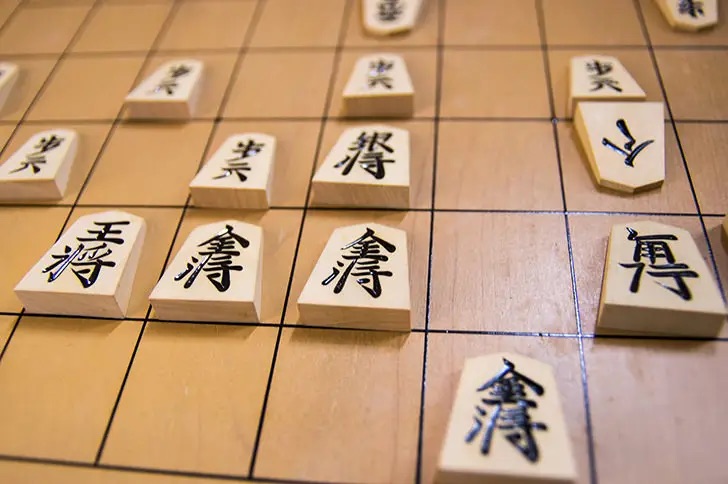
Welcome to your first Tsume Shogi (詰将棋) puzzle. This is a Mate in 1 — the simplest possible checkmate puzzle, requiring just one move to force checkmate against the opponent’s King. Master this pattern and you will begin to see checkmate opportunities appear naturally in your real games.
About This Puzzle: The Head Gold (Atama-kin)
This puzzle demonstrates the Atama-kin (頭金 / Head Gold) pattern — one of the most important and frequently occurring checkmate patterns in all of shogi. “Atama” means “head,” and “kin” means “gold general.” The checkmate is delivered by placing a gold general directly above the opponent’s King — on top of its “head.”
The Head Gold pattern appears in real games at every level, from beginners to professional title matches. Recognizing it instantly is a fundamental skill every shogi player must develop.
Puzzle: Black to Move — Find Checkmate in 1
Study the board below carefully. Black (Sente) must find a single move that delivers checkmate. The white King has no escape — find which move seals its fate.
🧩 頭金 1手詰め
Take your time before reading the answer below. Even simple puzzles build important thinking habits — never skip to the answer without attempting to solve it yourself.
Hint
- Look at the square directly above the white King
- Think about all the moves the Gold General can make
- Check that the King has no escape squares after your move
- Remember: you have a Gold General available in your piece reserve (hand pieces)
Answer and Explanation
The correct move is: Drop Gold directly above the King (頭金).
By placing the Gold General on the square immediately above the white King, you achieve checkmate for three simultaneous reasons:
- The Gold attacks the King directly — the King is in check with no way to capture the attacking piece
- The King cannot move forward — the Gold now occupies that square
- All surrounding squares are controlled — between your other pieces and the Gold itself, every square the King could move to is under attack
This is checkmate. The game is over in one move.
Why the Head Gold Pattern Is So Important
The Head Gold (Atama-kin) is not just a puzzle pattern — it is one of the most common checkmate finishers in actual shogi games. Here is why:
- Kings often sit exposed along the back rank — the square above the King is frequently undefended in real games
- Gold Generals are powerful endgame pieces — they move in 6 directions and are ideal for delivering final checkmates
- Drops make it unpredictable — the Gold does not need to travel to the right square; it can be dropped there instantly from your piece reserve
How the Gold General Moves
To understand why the Head Gold is so effective, you need to know how the Gold General moves. The Gold General can move to any of the 6 squares surrounding it — forward, backward, left, right, forward-diagonal-left, and forward-diagonal-right. It cannot move diagonally backward.
This movement makes the Gold General one of the most useful pieces for surrounding a King, because it covers exactly the squares that Kings tend to occupy when retreating.
Related Checkmate Patterns to Learn Next
The Head Gold is part of a family of Gold General checkmate patterns. Once you master it, study these related patterns:
Belly Gold (腹金 / Hara-kin)
A Gold General is placed directly to the side of the King — at the “belly” level. The King cannot move forward because other pieces block it, and the Gold cuts off the sideways escape. This pattern appears when the King has retreated to the edge rank.
Bottom Gold (尻金 / Shiri-kin)
A Gold General is placed directly below the King — at the “bottom.” This pattern typically occurs when the King is pinned against the top edge of the board (within the opponent’s back rank) or in the promotion zone. The King cannot move backward, and the Gold denies all forward movement.
Diagonal Gold (斜め金 / Naname-kin)
A Gold General placed diagonally adjacent to the King, combined with other pieces controlling the remaining escape squares. Less common than the three patterns above but still important to recognize.
How to Practice Checkmate Pattern Recognition
The goal of Tsume Shogi practice is to make checkmate patterns automatic — you want to see a position and immediately recognize the checkmate without having to calculate. Here is how to develop this skill:
- Solve the same puzzles multiple times — repetition burns the pattern into memory
- Time yourself — aim to solve 1-move mates instantly (under 3 seconds); this speed is achievable with practice
- Solve in volume — solving 10 puzzles daily is more effective than solving 100 puzzles once a week
- Look for patterns in real games — after each game you play, review the final position and identify which checkmate pattern ended the game
Beginner Tips for Tsume Shogi
- In every puzzle, every move you make must give check — non-checking moves are not allowed in Tsume Shogi
- The opponent always defends perfectly — assume the best possible defense and find a move that works anyway
- Piece drops (using pieces from your hand) are often part of the solution — always consider what pieces you have available to drop
- If a position feels too difficult, step back and re-examine which squares the King can escape to — then ask which move blocks all of them at once
What to Study Next
After mastering 1-move mates, the natural progression is:
- 3-move mates (3手詰め) — your move → opponent’s best response → your checkmate
- 5-move mates (5手詰め) — a three-step sequence with full opponent resistance
- 7-move and longer mates — complex endgame sequences that require precise calculation
Most shogi instructors recommend solving at least 100 one-move mates and 50 three-move mates before moving to longer sequences. The foundation of pattern recognition is built through repetition at the basic level.
Frequently Asked Questions
How many Tsume Shogi puzzles should I solve per day?
For beginners, 5–10 puzzles per day is an excellent target. Consistency matters far more than quantity. Five puzzles every day will produce more improvement than fifty puzzles once a week.
What if I cannot find the answer?
First, list every piece you have available to move or drop. Then list every square the King can move to. Then find the one move that attacks the King while covering all its escape squares. If you still cannot find it after 5 minutes, look at the answer — but make sure you understand exactly why it works before moving on.
Does Tsume Shogi actually improve real game performance?
Yes, significantly. Players who solve Tsume Shogi consistently develop faster tactical vision, stronger endgame calculation, and better intuition for when checkmate is near. Professional shogi players in Japan practice Tsume Shogi daily throughout their careers.
Summary
The Head Gold (Atama-kin) is the single most important checkmate pattern in shogi. It is simple, common, and instantly recognizable once you have seen it enough times. Mastering this pattern — and the related Gold General checkmates — gives you the tactical foundation you need to end games decisively when the opportunity arrives.
Keep practicing. Every puzzle you solve makes you faster, sharper, and better prepared to win when it matters.
- Tsume Shogi Overview — what Tsume Shogi is and how to practice it
- Shogi Pieces Guide — review how the Gold General moves
- Complete Shogi Rules — review check and checkmate rules
コメントを残す