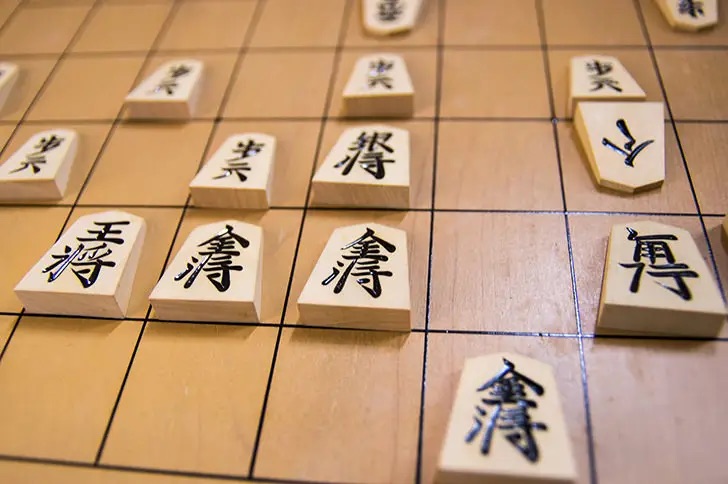
Before you can play shogi, you need to know how to set up the board correctly. Unlike many board games, shogi’s initial position is specific and consistent — every piece has a designated starting square. In this guide, you will learn the exact starting position of every piece, how to orient the board, and the key conventions that shogi players follow when setting up a game.
What You Need
To play shogi, you need:
- A shogi board (将棋盤, shogi-ban) — a 9×9 grid, usually with coordinate labels along the edges
- Two sets of pieces (駒, koma) — 20 pieces per player, 40 total
- A flat surface where both players can sit facing each other
If you are playing online or using a shogi app, the setup is done automatically. But understanding the starting position is fundamental to your knowledge of the game.
Board Orientation
The shogi board is a 9×9 grid. Columns are numbered 9 to 1 from right to left (from the perspective of the player sitting at the south end of the board). Rows are numbered 1 to 9 from top to bottom (from the same perspective). So the top-right square from the first player’s viewpoint is column 9, row 1, written as 9一 or 9-1.
Each player’s “home” territory consists of the three rows closest to them (rows 7, 8, and 9 for the first player). Pieces that enter the opponent’s territory (rows 1–3 from the first player’s perspective) become eligible to promote.
The Starting Position — Piece by Piece
Here is the complete starting setup. All 40 pieces are placed on the board before the game begins. Each player’s pieces are oriented to point toward the opponent.
Back Rank (Row 9 for Player 1)
From right to left: Lance (香車), Knight (桂馬), Silver General (銀将), Gold General (金将), King (玉将/王将), Gold General (金将), Silver General (銀将), Knight (桂馬), Lance (香車).
This gives the back rank a symmetric structure, with the King protected in the center and matching pairs on both sides.
Middle Row (Row 8 for Player 1)
Only two pieces are placed in this row: a Bishop (角行) on column 8 (second from the right) and a Rook (飛車) on column 2 (second from the left). These two powerful pieces occupy opposite sides of the board, creating an asymmetric dynamic from the very first move.
Pawn Row (Row 7 for Player 1)
All nine Pawns (歩兵) are lined up one per column across row 7. This creates a defensive barrier in front of your pieces and provides the raw material for early pawn attacks.
Opponent’s Setup
The second player’s pieces mirror the first player’s position exactly. Row 1 is the opponent’s back rank (Lance, Knight, Silver, Gold, King, Gold, Silver, Knight, Lance), row 2 has the opponent’s Rook on file 8 and Bishop on file 2 (mirror of the first player), and row 3 has all nine of the opponent’s Pawns.
Key Piece Count
Before starting a game, many experienced players count their pieces to verify the setup is correct:
- 9 Pawns (歩兵) per player
- 2 Lances (香車) per player
- 2 Knights (桂馬) per player
- 2 Silver Generals (銀将) per player
- 2 Gold Generals (金将) per player
- 1 Bishop (角行) per player
- 1 Rook (飛車) per player
- 1 King (玉将 or 王将) per player
That is 20 pieces per player, 40 total on the board at the start of the game.
Which King Goes Where?
In standard shogi sets, one King piece is marked 玉将 (gyokusho) and the other is marked 王将 (osho). By tradition, the challenger or lower-ranked player uses the 玉将 and the higher-ranked or host player uses the 王将. In casual play between friends, the distinction does not matter — simply place one king on each side.
First Move Convention
In shogi, the player who moves first is often determined by a simple randomization ritual called furigoma (振り駒). One player takes five pawns and tosses them into the air. If more pawns land with the promoted side (と金, “to-kin”) face up, that player goes second. If more land with the unpromoted side up, they go first. In online play, this is handled automatically.
Setting Up Handicap Games
When players of significantly different skill levels play together, handicap games (駒落ち, komochi) allow the stronger player to remove one or more of their powerful pieces before the game starts. Common handicaps include:
- Lance drop (香落ち): Stronger player removes one Lance
- Bishop drop (角落ち): Stronger player removes their Bishop
- Rook drop (飛車落ち): Stronger player removes their Rook
- Rook-Bishop drop (二枚落ち): Stronger player removes both Rook and Bishop
Handicap games are an excellent way for beginners to practice against stronger opponents while keeping the game competitive.
Practice Tip
The fastest way to memorize the starting position is simply to set up the board by hand several times. Within three or four repetitions, the layout becomes second nature. Many shogi players find that the act of physically arranging the pieces is itself a meditative ritual that helps them focus before a game.
Once you are confident with the setup, move on to Lesson 5: Complete Shogi Rules for Beginners, where you will learn every rule you need to play a full legal game.
コメントを残す